Wednesday, June 7, 2017

Two SIM Cards and Better Selfies: How China’s Smartphones Are Taking On Apple

SHENZHEN, China—The top player in Africa's fast-growing smartphone market isn't Apple Inc. or Samsung Electronics Co. It is Transsion Holdings Ltd., an obscure Chinese manufacturer that won customers by offering handsets with features targeted to local markets.

Transsion—whose products are sold under the Tecno, itel and Infinix brand names—developed handsets with two SIM-card slots after research showed people were carrying...


Source: Two SIM Cards and Better Selfies: How China's Smartphones Are Taking On Apple

Tuesday, June 6, 2017

US tech firms should keep trying to crack China, trade body says

U.S. technology companies like Facebook and Google should still keep trying to get into China despite censorship and other challenges because the rewards could be big, the head of a trade body told CNBC on Wednesday.

Many American technology firms have struggled in China. Facebook and Google are both banned under the censorship regime in the world's second-largest economy.

Gary Shapiro, president and CEO of the Consumer Technology Association, which represents 2,200 firms, made the comments as the annual Consumer Electronics Show Asia kicked off. CES is held in Las Vegas every year and showcases the latest gadgets and technology. But the organization also holds an event in Asia, which is now in its third year.

"There are challenges … there is still major censorship that goes on here. But if you can get into the market, if you could get the partner, if you can understand the rather vague and ambiguous market, you have a huge market of 1.4 billion people and a lot of them are middle and upper class," Shapiro told CNBC.

Some U.S. technology firms have publicly said China is not a market they are focusing all their efforts on in the short-term. Reed Hastings, CEO of Netflix, told CNBC in May that China was "off the table for the next couple of years." Yet despite the challenges, there are definitely rewards.

"It is tough to get in this market, but it's worth it," Shapiro said.

The CTA head discussed the relationship between the U.S. and Chinese governments and said there is a "much better relationship" than anyone thought there would be after the anti-Chinese rhetoric during last year's election campaign. Then-candidate Donald Trump had threatened to brand China as a currency manipulator, but his administration has since backed away from that label.


Source: US tech firms should keep trying to crack China, trade body says

Monday, June 5, 2017

China’s top 10 unicorn companies

CB Insights recently posted its list of 197 world unicorns, also known as a private company valuing more than USD 1 billion. Here is the top 10 unicorn companies in China that AllChinaTech has picked by valuation from CB Insights' list.

Didi Chuxing

How will China's ride-hailing rules affect the market?Photo from Baidu Images

Founded in: 2012

Headquarters: Beijing

Financing status: USD 5.5 billion in pre-IPO financing in April 2017

Didi Chuxing is China's largest ride-hailing app and possessed 93.1% of the market share in August last year when it acquired Uber China.

The app has attracted 400 million users and offered services including taxi hailing, private car hailing, car pooling, car rental, and so on. In 2016, as many as 20 million rides were completed on DiDi on a daily basis.

Xiaomi

Xiaomi offline store. Photo from Miui.com.Xiaomi offline store. Photo from Miui.com.

Founded in: 2010

Headquarters: Beijing

Financing status: undisclosed Series E round in April 2015

Xiaomi is founded by veteran engineer Lei Jun, who was previously the CEO of office software giant Kingsoft.

Xiaomi started its business by manufacturing smartphones at extremely low cost performance ratios and coined the term "Xingneng Guaishou", which literally means "performance monster". Its first batch of users are geeks and hardcore gadget buyers who are attracted to these high tech performance parts. Over the last few years, the company gradually added more products such as smart televisions, air purifiers, and e-scooters to its line.

Lu.com

fintechPhoto from Pixabay.com

Founded in: 2011

Headquarters: Shanghai

Financing status: USD 1.2 billion Series B round in January 2016

Shanghai is the financial center of China, and Lujiazui is the financial center of Shanghai. Lu.com is a fintech company based in Lujiazui, offering peer-to-peer personal loan services to its users.

Its latest investors include BlackPine Private Equity Partners, CDH Investments and China International Capital Corporation's private equity division, according to a news release featured on Lu.com.

Meituan Dianping

Photo from Pixabay.comPhoto from Pixabay.com

Founded in: 2010

Headquarters: Beijing

Financing status: Undisclosed financing round of more than USD 100 million in July 2016

Meituan Dianping, or China Internet Plus Holdings Ltd (CIP), was formed when group buying platform Meituan and Dianping, also known as China's Yelp, announced their merger in October 2015.

After that, the new company enjoyed 80 percent of China's group purchasing market, and became the biggest online-to-offline company in China.

Toutiao

Photo from Pixabay.comPhoto from Pixabay.com

Founded in: 2012

Headquarters: Beijing

Financing status: USD 1 billion Series D round in April 2017

Toutiao is a Flipboard-like news aggregator app that recommends news content using computer algorithms based on deep learning and data mining technology. When you read Toutiao, Toutiao also reads you, keeping track of your browsing history, your clicks, your comments, and time spent on every article.

The company claimed that it had more than 47 million daily active users in May 2016, having served more than 480 million users. It was valued at USD 500 million when it closed a Series C financing round worth USD 100 million, as reported by Tencent Tech in June.

DJI

Photo from www.jiqiren365.comPhoto from www.jiqiren365.com

Founded in: 2006

Headquarters: Shenzhen

Financing status: USD 75 million Series C round in May 2015

This company is a world leader in camera drones and quadcopters, taking up 70 percent of the global consumer drone market. It has up to 3,000 employees in its Shenzhen headquarters and has branched out to Beijing, Hong Kong, the U.S., Germany and Japan.

Its official website says it now makes different types of drones that can be used in aerial photography, filmmaking, agriculture, search and rescue, energy infrastructure, remote sensing mapping and more.

Zhong An Insurance

(Photos from Baidu Images)Photos from Baidu Images

Founded in: 2013

Headquarters: Shanghai

Financing status: USD 934 million Series A round in June 2015

This online insurance provider offers more than 200 insurance products and has written over 3.6 billion policies for over 300 million customers by the end of 2015. It is the first company that obtained an internet insurance license in China.

Zhong An Insurance is backed by Chinese e-commerce giant Alibaba, top Internet company Tencent and leading insurance provider Ping An.

Lianjia

housePhoto from Pixabay.com

Founded in: 2001

Headquarters: Beijing

Financing status: RMB 3 billion (USD 441 million) Series D round in April 2017

Lianjia – or Homelink – is China's leading real estate service platform. It has expanded its network to large Chinese cities including Shanghai, Guangzhou, and Chengdu via acquisitions and investments.

As of April 2016, it has covered 24 cities with 5,000 physical stores and 100,000 agents, achieving an annual Gross Merchandise Volume (GMV) of RMB 709 billion.

Meizu Technology

Photo from MeizuPhoto from Meizu

Founded in: 2003

Headquarters: Shenzhen

Financing status: RMB 200 million (USD 29 million) Series B round in October 2016

Meizu started manufacturing MP3 players before it transformed itself to a smartphone company in 2007.

In February 2015, China's e-commerce giant Alibaba bought shares in Meizu for USD 590 million to promote its "YunOS" operating system. Meizu sold more than 20 million phones in 2015.

Ele.me

elemePhoto from Baidu Images

Founded in: 2008

Headquarters: Shanghai

Financing status: RMB 1.25 billion (USD 285 million) Series F round in April 2016

Alibaba-backed Ele.me is a leading Chinese food delivery app. According to data released in December 2015 by Ele.me, its daily transaction volume has amounted to RMB 100 million with more than 3.3 million daily orders by the end of 2015.

According to Zhang Xuhao, CEO of Ele.me, the company has covered 1,000 cities in China and has a user base of 70 million people. Domestically, it competes with Meituan-Dianping and Baidu Delivery in food delivery.

(Top photo from Pixabay.com)


Source: China's top 10 unicorn companies

Sunday, June 4, 2017

Vivo becomes official smartphone sponsor of the 2018 and 2022 FIFA World Cup

Vivo was presented today as FIFA's official smartphone sponsor under a sponsorship agreement that will run until 2022 and include the next editions of the FIFA World Cup™ in 2018 and 2022. The announcement was made today in Beijing at the historical and iconic Imperial Ancestral Temple in the presence of Vivo Executive Vice-President Ni Xudong and FIFA Secretary General Fatma Samoura.

As FIFA's official smartphone brand, Vivo will sponsor the 2018 and 2022 FIFA World Cups as well as the FIFA Confederations Cup. The global reach of this six-year partnership is set to take Vivo to new heights.

The Vivo logo will appear during every match on pitch advertising boards, match tickets, media releases and other key promotional platforms. The agreement includes special marketing activations such as the right to select guests to be a Vivo phone photographer during pre-match player warm-ups.

Vivo will also gradually introduce a customised FIFA World Cup™ phone that will offer a unique experience for football fans around the world.

Ni Xudong explained: "Football is a sport full of passion and moments of wonder, creating happiness for millions of people. The spirit of football is about constant progress.

As a global sponsor of the FIFA World Cup, Vivo hopes to strongly associate itself with the football spirit and show consumers all over the world Vivo's creative, joyful and international brand image. In the meantime, Vivo will bring more personalised, energetic and youthful elements to the FIFA World Cup experience and the game of football."

Speaking about the new agreement, FIFA Secretary General Fatma Samoura said: "Football and technology are coming closer by the day, on and off the pitch, and it is a great moment to start a partnership of this nature with the leading global smartphone brand. We are very excited to be working closely with Vivo and keen to see their involvement in the next editions of the FIFA World Cup and FIFA Confederations Cup."

Vivo's previous involvement in sport includes the title sponsorship of the Indian Premier League cricket competition and a strategic partnership with the NBA to become NBA China's official mobile handset sponsor.


Source: Vivo becomes official smartphone sponsor of the 2018 and 2022 FIFA World Cup

Saturday, June 3, 2017

7 in 10 Smartphone Apps Share Your Data with Third-Party Services

The following essay is reprinted with permission from The Conversation, an online publication covering the latest research.The Conversation

Our mobile phones can reveal a lot about ourselves: where we live and work; who our family, friends and acquaintances are; how (and even what) we communicate with them; and our personal habits. With all the information stored on them, it isn't surprising that mobile device users take steps to protect their privacy, like using PINs or passcodes to unlock their phones.

The research that we and our colleagues are doing identifies and explores a significant threat that most people miss: More than 70 percent of smartphone apps are reporting personal data to third-party tracking companies like Google Analytics, the Facebook Graph API or Crashlytics.

When people install a new Android or iOS app, it asks the user's permission before accessing personal information. Generally speaking, this is positive. And some of the information these apps are collecting are necessary for them to work properly: A map app wouldn't be nearly as useful if it couldn't use GPS data to get a location.

But once an app has permission to collect that information, it can share your data with anyone the app's developer wants to—letting third-party companies track where you are, how fast you're moving and what you're doing.

The help, and hazard, of code libraries

An app doesn't just collect data to use on the phone itself. Mapping apps, for example, send your location to a server run by the app's developer to calculate directions from where you are to a desired destination.

The app can send data elsewhere, too. As with websites, many mobile apps are written by combining various functions, precoded by other developers and companies, in what are called third-party libraries. These libraries help developers track user engagement, connect with social media and earn money by displaying ads and other features, without having to write them from scratch.

However, in addition to their valuable help, most libraries also collect sensitive data and send it to their online servers—or to another company altogether. Successful library authors may be able to develop detailed digital profiles of users. For example, a person might give one app permission to know their location, and another app access to their contacts. These are initially separate permissions, one to each app. But if both apps used the same third-party library and shared different pieces of information, the library's developer could link the pieces together.

Users would never know, because apps aren't required to tell users what software libraries they use. And only very few apps make public their policies on user privacy; if they do, it's usually in long legal documents a regular person won't read, much less understand.

Developing Lumen

Our research seeks to reveal how much data are potentially being collected without users' knowledge, and to give users more control over their data. To get a picture of what data are being collected and transmitted from people's smartphones, we developed a free Android app of our own, called the Lumen Privacy Monitor. It analyzes the traffic apps send out, to report which applications and online services actively harvest personal data.

Because Lumen is about transparency, a phone user can see the information installed apps collect in real time and with whom they share these data. We try to show the details of apps' hidden behavior in an easy-to-understand way. It's about research, too, so we ask users if they'll allow us to collect some data about what Lumen observes their apps are doing—but that doesn't include any personal or privacy-sensitive data. This unique access to data allows us to study how mobile apps collect users' personal data and with whom they share data at an unprecedented scale.

In particular, Lumen keeps track of which apps are running on users' devices, whether they are sending privacy-sensitive data out of the phone, what internet sites they send data to, the network protocol they use and what types of personal information each app sends to each site. Lumen analyzes apps traffic locally on the device, and anonymizes these data before sending them to us for study: If Google Maps registers a user's GPS location and sends that specific address to maps.google.com, Lumen tells us, "Google Maps got a GPS location and sent it to maps.google.com"—not where that person actually is.

Trackers are everywhere

More than 1,600 people who have used Lumen since October 2015 allowed us to analyze more than 5,000 apps. We discovered 598 internet sites likely to be tracking users for advertising purposes, including social media services like Facebook, large internet companies like Google and Yahoo, and online marketing companies under the umbrella of internet service providers like Verizon Wireless.

We found that more than 70 percent of the apps we studied connected to at least one tracker, and 15 percent of them connected to five or more trackers. One in every four trackers harvested at least one unique device identifier, such as the phone number or its device-specific unique 15-digit IMEI number. Unique identifiers are crucial for online tracking services because they can connect different types of personal data provided by different apps to a single person or device. Most users, even privacy-savvy ones, are unaware of those hidden practices.

More than just a mobile problem

Tracking users on their mobile devices is just part of a larger problem. More than half of the app-trackers we identified also track users through websites. Thanks to this technique, called "cross-device" tracking, these services can build a much more complete profile of your online persona.

And individual tracking sites are not necessarily independent of others. Some of them are owned by the same corporate entity—and others could be swallowed up in future mergers. For example, Alphabet, Google's parent company, owns several of the tracking domains that we studied, including Google Analytics, DoubleClick or AdMob, and through them collects data from more than 48 percent of the apps we studied.

Users' online identities are not protected by their home country's laws. We found data being shipped across national borders, often ending up in countries with questionable privacy laws. More than 60 percent of connections to tracking sites are made to servers in the U.S., U.K., France, Singapore, China and South Korea—six countries that have deployed mass surveillance technologies. Government agencies in those places could potentially have access to these data, even if the users are in countries with stronger privacy laws such as Germany, Switzerland or Spain.

Even more disturbingly, we have observed trackers in apps targeted to children. By testing 111 kids' apps in our lab, we observed that 11 of them leaked a unique identifier, the MAC address, of the Wi-Fi router it was connected to. This is a problem, because it is easy to search online for physical locations associated with particular MAC addresses. Collecting private information about children, including their location, accounts and other unique identifiers, potentially violates the Federal Trade Commission's rules protecting children's privacy.

Just a small look

Although our data include many of the most popular Android apps, it is a small sample of users and apps, and therefore likely a small set of all possible trackers. Our findings may be merely scratching the surface of what is likely to be a much larger problem that spans across regulatory jurisdictions, devices and platforms.

It's hard to know what users might do about this. Blocking sensitive information from leaving the phone may impair app performance or user experience: An app may refuse to function if it cannot load ads. Actually, blocking ads hurts app developers by denying them a source of revenue to support their work on apps, which are usually free to users.

If people were more willing to pay developers for apps, that may help, though it's not a complete solution. We found that while paid apps tend to contact fewer tracking sites, they still do track users and connect with third-party tracking services.

Transparency, education and strong regulatory frameworks are the key. Users need to know what information about them is being collected, by whom, and what it's being used for. Only then can we as a society decide what privacy protections are appropriate, and put them in place. Our findings, and those of many other researchers, can help turn the tables and track the trackers themselves.

This article was originally published on The Conversation. Read the original article.


Source: 7 in 10 Smartphone Apps Share Your Data with Third-Party Services

Friday, June 2, 2017

Nubia has a new flagship smartphone with 8GB RAM and Quick Charge 4+ support

There are a couple of new flagship smartphones running on Snapdragon 835 processor these days. This includes the Sony Xperia XZ Premium, Xiaomi Mi 6, HTC U11 and the Galaxy S8 for the US market. If you're looking for that extra edge, ZTE's sub-brand Nubia has a new flagship smartphone that stands out as an interesting alternative.

Meet the Nubia Z17. It's the first Snapdragon 835 powered device to come with 8GB of RAM and it's also the first to incorporate Qualcomm's latest QuickCharge 4+.

The Nubia Z17 features a 5.5″ Full HD display and it runs on Qualcomm's top of the line Snapdragon 835 processor mated to 8GB of RAM and has 128GB of UFS 2.1 storage. This is the second smartphone to feature 8GB of RAM after the ZenFone AR.

For imaging, the Z17 features a dual-camera system with a 23MP + 12MP combo that has a 1.4 micron pixel size and f/1.8 aperture. It boasts a 0.03-second ultra-fast focusing speed and comes with a hybrid 2X zoom feature.

The body of the Z17 is said to be 98% metal and it's also listed as the first outdoor waterproof Nubia phone but there's no mention of its IP rating. The device also comes with a machine learning feature that will optimise the device according to your usage for a better experience.

Keeping the device powered is a 3,200mAh battery which is rated to last up to 2.4 days with its NeoPower 3.0 power saving system. It comes with a NeoCharge Quick Charging feature which can do 50% charge in 20 minutes. This charging technology is based on Quick Charge 4+.

According to Qualcomm, the latest Quick Charge 4+ offers the same benefits as Quick Charge 4 and it comes with better thermal management, faster charging and better safety features. It comes with Dual Charge, that comes with a second power management IC which helps to lower thermal dissipation while reducing charge times. In summary, a Quick Charge 4+ compatible device can offer up to 15% faster charging or 30% better efficiency compared to Quick Charge 4. Quick Charge 4 promises 50% charge in just 15 minutes for a device with a 2,750mAh battery.

In China, the Nubia Z17 with 8GB RAM and 128GB storage is going for 3,999CNY which is about RM2,512. It will be available in 5 colours – Aurora Blue, Black Gold, Obsidian Black, Solar Gold and Flame Red.

[ SOURCE 2 ]

Related


Source: Nubia has a new flagship smartphone with 8GB RAM and Quick Charge 4+ support

Thursday, June 1, 2017

Face-off: which smartphone takes the best photos - Samsung Galaxy S8+ or Huawei P10 Plus? Our photo editor’s verdict

Samsung officially released its new Galaxy S8 phones in Hong Kong in May and reviewers have been smitten not only by its super slick design but impressive processing power. Both the S8 and S8+ also boast top-end camera specs, a slight upgrade from those of the S7 series.

But how does the S8+ stack up against the Huawei P10 Plus when it comes to smartphone photography? We crowned the P10, its smaller (and cheaper) sister, the best camera phone in a comparison with two other top-of-the range models, the LG G6 and Sony Xperia XZs, in April.

Which smartphone takes the best photos – the LG G6, Huawei P10 or Sony Xperia XZs? Our photo editor's verdict

Once again, we have asked South China Morning Post photo editor for Culture and Lifestyle Antony Dickson to test out the rear cameras on the two handsets. For testing, we used loan units provided by the brands; Dickson shot in auto mode with resolution set to the highest in broad daylight, as well as in low light conditions with no flash. Here are his observations and verdict.

Samsung Galaxy S8 full review: at HK$5,698 it's pricey but there's a lot to like, from its feel to its look to its processing power

Daylight images:

In general, the Huawei tended to capture slightly more information, or have a greater dynamic range, producing a slightly more gentle graduation from the highlights to the shadows - meaning more details in the darker parts of the images as well as well as the lighter parts - than the Samsung. But there is more to good image quality than a simple histogram.

For instance, take a look at the images below of seafood taken from above.

The Huawei camera tended to have smoother range of images, but the Samsung perhaps provided more overall attractive image. In this case the colour balance and saturation of the Samsung was nicer.

Another example is the polystyrene boxes (below) that are bright and shimmering, with nice shadow detail, in the S8+, which was how my eyes saw it.

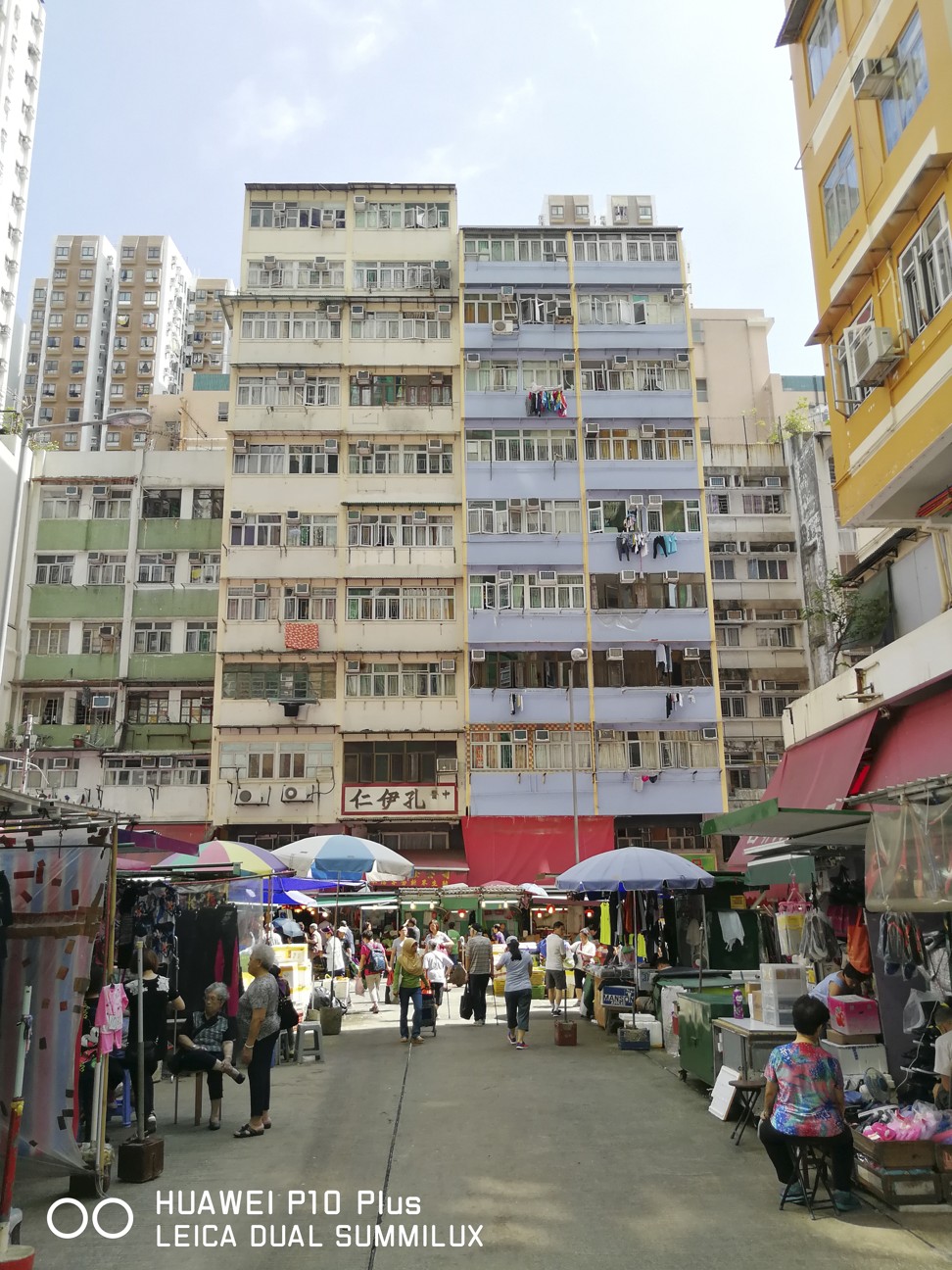
Again, these images of the vertical building are slightly darker and, therefore, more saturated when shot with the Samsung Galaxy S8+ than with the Huawei P10 Plus.

Sharpness wise, both cameras are very good, with nice sharpness in the corners, even though the images, according to the data, were shot at a wide open aperture, which is where lenses generally perform the worst, with a low ISO (Huawei 125 vs Samsung 50) and a fast shutter speed (1/900 vs 1/1200) to stop hand/camera shake.

The last outdoor test was to shoot in perhaps the most challenging conditions for a camera/lens, shooting subjects backlit.

Funnily enough this is where the Samsung shone through. The Samsung's image were crisper, an accurate colour balance, and strangely showed very little pixilation, i.e. a less grainy in the shadows, and nice smooth exposure and image quality.

The Huawei, on the other hand, was a touch green, the image's pixels starting to break up at higher magnification. Again, though, the P10 Plus did capture more details in the highlights and shadows, but I would say the Samsung shot looks a lot better.

Low light images:

These images were shot in an indoor gym, with all but one fluorescent light turned off.

The Huawei shot was taken at ISO 3200, speed 1/17s, aperture f1.8, with file size 6MB. The pixels retain good structure, more like a traditional grain, contrasty and sharp. Colour balance is good, with a slightly warm tone, and a nice gradation from highlights to shadows, albeit slightly more contrasty.

Exposure, if anything, is a sliver under, i.e. a touch dark. Moody but an accurate feel of the dark corner we took the image in.

The Samsung shot was taken at ISO 1000, speed 1/10, aperture f1.7, with file size 4.2MB. The pixels at 300 per cent do become more blurry and texturised than the Huawei.

Colour balance is a touch green, the image is less contrasty and a little flatter, as can be seen in the histogram, which captures a little less of the shadow detail, and in the highlights. It seems the Samsung has made a more neutral image, less contrasty, bringing the subject's exposure into a narrower dynamic range (i.e. less shadow and less highlights information).

Verdict:

The Huawei P10 Plus performs better in low light. Even though it was shot using an ISO substantially higher than the Samsung Galaxy S8+ (3200 vs 1000), the grain structure of its low light image is better at higher magnification; the dynamic range makes the image a little more moody, with shadows and highlights well represented and captures the actual lighting well, and the colour balance was pretty spot-on.

The Huawei may be a little sharper due to the faster shutter speed of 1/17 versus Samsung's 1/10, and also due to the sharper pixels from the sensor and the more contrasty image.

It's a very close call. If you like taking images of ping pong players in dim lighting, then go with the Huawei P10+. But if I had to make a choice between the two phones, I would choose the Samsung. The daylight images have good colour balance, nice exposure, correct saturation and nice pop straight out of the phone. Just what I would want from a phone camera, good-quality and simple.


Source: Face-off: which smartphone takes the best photos - Samsung Galaxy S8+ or Huawei P10 Plus? Our photo editor's verdict